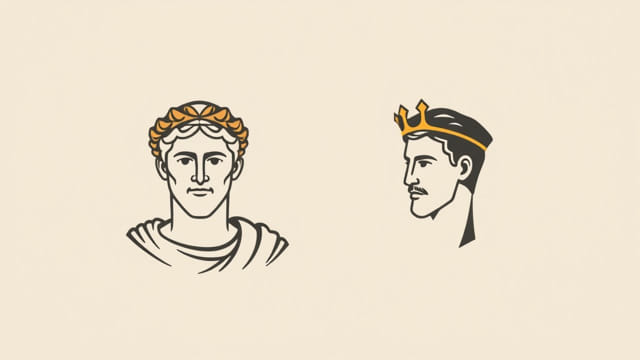
Julius Caesar and Augustus were two of the most influential figures in Roman history, shaping the transition from Republic to Empire in distinct but interconnected ways. While they were related by blood and ambition, their approaches to leadership, military power, and political reform were quite different. Comparing Julius Caesar and Augustus reveals not only the evolution of Roman political power but also the changing nature of leadership during a period of crisis and transformation in ancient Rome. Both leaders played pivotal roles in Roman history, yet their legacies unfolded in contrasting styles and with different outcomes.
Background and Rise to Power
Julius Caesar: The Ambitious General
Born in 100 BCE, Gaius Julius Caesar belonged to a patrician family but had to climb the political ladder through a mixture of alliances, military campaigns, and charisma. His rise began with his military successes in Gaul, where he expanded Roman territory and gained immense popularity among his troops and the public. Caesar’s crossing of the Rubicon in 49 BCE marked a critical turning point, defying the Roman Senate and leading to a civil war. Eventually, he became dictator for life in 44 BCE, a move that alarmed many in the Senate and led to his assassination.
Augustus: The Cautious Heir
Gaius Octavius, later known as Augustus, was the adopted son and heir of Julius Caesar. After Caesar’s assassination, Octavian formed the Second Triumvirate with Mark Antony and Lepidus to avenge Caesar’s death and defeat his assassins. After consolidating power, he outmaneuvered his rivals, including Antony and Cleopatra, ultimately becoming Rome’s first emperor in 27 BCE. Augustus cleverly maintained the appearance of a restored Republic while holding absolute power, taking the title ‘Princeps’ rather than ‘dictator’ or ‘king.’
Military Leadership and Strategy
Caesar’s Conquests
Julius Caesar is best remembered for his military brilliance. His conquest of Gaul between 58 and 50 BCE not only enriched Rome but also demonstrated his tactical genius. He was a hands-on general who led from the front, earning the loyalty of his soldiers. His campaigns were documented in his own writings, especially in ‘Commentarii de Bello Gallico,’ showcasing his skills both as a commander and a propagandist.
Augustus’ Consolidation
Unlike Caesar, Augustus was not a frontline commander. Instead, he relied on capable generals like Agrippa to handle military affairs. His strength lay in organization and strategic delegation. After securing his rule, Augustus focused more on securing the empire’s borders than on expansion. His reign marked the beginning of the Pax Romana, a long period of relative peace and stability.
Political Reforms and Governance
Caesar’s Radical Changes
Caesar implemented sweeping reforms during his time as dictator. He centralized authority, reduced the power of the Senate, and restructured the Roman calendar into the Julian calendar. While these changes aimed to strengthen Rome, they also alienated many in the elite class. His apparent disregard for traditional republican values contributed to his downfall.
Augustus’ Subtle Transformation
Augustus took a more calculated approach. Instead of abolishing republican institutions, he preserved them in form while hollowing them out in practice. He maintained the Senate, consuls, and assemblies, but ultimate authority resided with him. His reforms stabilized the government, improved infrastructure, and introduced social programs. By presenting himself as the restorer of the Republic, he avoided the fate of his adoptive father.
Public Image and Propaganda
Julius Caesar’s Persona
Caesar crafted an image of himself as a heroic general and populist leader. His writings, statues, and public games were tools to cultivate support. However, his rapid accumulation of power, crowned statues, and divine honors created fear among senators that he intended to become a monarch, fueling the conspiracy against him.
Augustus’ Political Theater
Augustus mastered the art of political messaging. He presented himself as the humble servant of the Republic, using titles like ‘Princeps’ and avoiding overt symbols of kingship. Through literature, architecture, and coinage, he promoted the image of a savior who had brought peace and prosperity. Poets like Virgil and Horace glorified his reign, reinforcing his legacy as a benevolent ruler.
Legacy and Impact on Rome
Caesar’s Short-Lived Rule
Despite his dramatic impact, Julius Caesar ruled for only a brief period. His assassination on the Ides of March in 44 BCE plunged Rome into further chaos. Yet, his actions set the stage for the end of the Republic. His name became synonymous with power Caesar would later be used as a title by emperors in Rome and beyond.
Augustus’ Enduring Empire
Augustus ruled for over 40 years, establishing the principate and laying the foundation of the Roman Empire. His era ushered in administrative efficiency, economic growth, and cultural achievements. By securing a peaceful succession and redefining Roman governance, Augustus ensured the Empire’s longevity long after his death in 14 CE.
Comparative Summary
- Leadership Style: Caesar was bold and direct, while Augustus was cautious and strategic.
- Military Role: Caesar was a battlefield commander; Augustus worked through trusted generals.
- Governance: Caesar concentrated power openly; Augustus disguised his autocracy under republican forms.
- Legacy: Caesar changed the course of Roman history; Augustus institutionalized those changes.
The comparison between Julius Caesar and Augustus reveals two powerful yet contrasting figures in Roman history. While Julius Caesar shattered the old system with his ambition and charisma, Augustus rebuilt it into something entirely new and lasting. Both men were reformers, visionaries, and architects of a new Rome, but they operated with very different tools. Caesar’s legacy lies in his revolutionary impact, while Augustus’ legacy is defined by stability and empire building. Together, they represent the transformation of Rome from a struggling republic to one of the most formidable empires in world history.