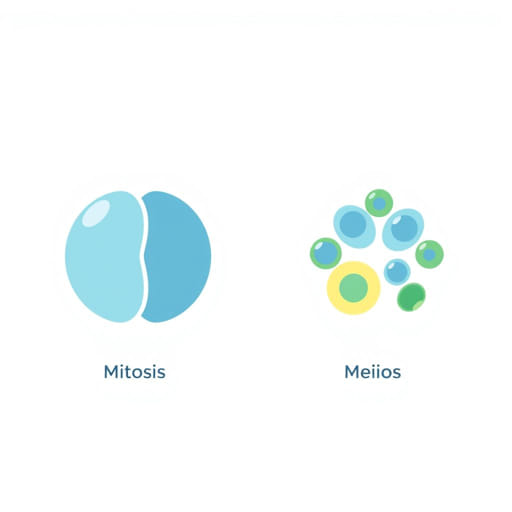
How Is Meiosis Comparably Different from Mitosis? A Simple Guide to Cell DivisionThe processes of meiosis and mitosis are both essential for life, but they serve different purposes and follow distinct pathways. These two types of cell division are often taught together because comparing them helps clarify how they work. While they share some similarities, their differences are fundamental especially in terms of genetic variation, chromosome number, and their roles in the body.
This topic explores how meiosis differs from mitosis, highlighting the most important features in a way that’s clear and easy to understand.
What Is Cell Division?
Cell division is the process by which a single cell splits into two or more cells. It plays a key role in growth, repair, and reproduction.
-
Mitosis is the process that allows organisms to grow and repair damaged tissues by producing genetically identical cells.
-
Meiosis is the process that leads to the formation of gametes (sperm and egg cells), and introduces genetic diversity through recombination and reduction of chromosome number.
Basic Overview of Mitosis
Mitosis occurs in somatic cells (non-reproductive cells). It results in two identical daughter cells, each with the same number of chromosomes as the original parent cell.
Key features of mitosis
-
Produces 2 diploid cells
-
Occurs in body cells
-
Maintains chromosome number
-
No genetic variation introduced
-
Involves one division cycle
Mitosis is essential for
-
Tissue repair
-
Growth
-
Asexual reproduction in some organisms
Basic Overview of Meiosis
Meiosis happens only in germ cells cells that will become sperm or eggs. The main goal of meiosis is to produce gametes with half the number of chromosomes so that when fertilization occurs, the full chromosome number is restored.
Key features of meiosis
-
Produces 4 haploid cells
-
Occurs in reproductive organs
-
Halves the chromosome number
-
Introduces genetic variation
-
Involves two division cycles
Meiosis ensures that
-
Offspring inherit a combination of genes from both parents
-
Chromosome number stays constant from generation to generation
Chromosome Number Diploid vs. Haploid
One major difference between mitosis and meiosis is the number of chromosomes in the resulting cells.
-
Mitosis produces diploid cells (2n), which have a full set of chromosomes just like the parent cell.
-
Meiosis produces haploid cells (n), which have half the number of chromosomes. This is important because during fertilization, two haploid cells (egg and sperm) combine to form a diploid zygote.
Number of Divisions
Another key distinction is how many times the nucleus divides.
-
Mitosis involves one division producing two cells.
-
Meiosis involves two divisions meiosis I and meiosis II resulting in four cells.
These extra steps in meiosis are necessary to ensure that gametes have half the normal number of chromosomes.
Genetic Variation
One of the most important differences lies in the genetic outcomes.
-
Mitosis produces identical cells. There is no mixing of genetic material.
-
Meiosis, on the other hand, creates genetically unique cells through two key processes
-
Crossing over during prophase I, where parts of homologous chromosomes are exchanged
-
Independent assortment, where chromosomes are randomly distributed into gametes
-
This variation is essential for evolution and natural selection, giving offspring a better chance of adapting to changing environments.
Phases Similar Names, Different Functions
Both mitosis and meiosis go through similar-sounding phases prophase, metaphase, anaphase, and telophase. But they differ in what happens during those phases.
In mitosis
-
Chromosomes line up individually
-
Sister chromatids separate
In meiosis
-
In meiosis I, homologous chromosomes pair up and separate
-
In meiosis II, sister chromatids separate (similar to mitosis)
Because of this, meiosis is more complex and takes longer than mitosis.
Where They Occur
-
Mitosis takes place in all parts of the body, except the reproductive organs.
-
Meiosis occurs only in the ovaries and testes, where gametes are formed.
Each process is tightly regulated and controlled to maintain balance in the body.
Why the Differences Matter
These differences aren’t just for textbooks they matter for life itself.
-
Without mitosis, you wouldn’t be able to grow, heal wounds, or replace dying cells.
-
Without meiosis, humans wouldn’t be able to reproduce properly, and every new generation would have double the chromosomes of the last.
Meiosis introduces diversity, which helps populations adapt and survive. Mitosis maintains stability, which keeps individual organisms healthy.
Summary Table Meiosis vs. Mitosis
| Feature | Mitosis | Meiosis |
|---|---|---|
| Number of divisions | 1 | 2 |
| Number of cells produced | 2 | 4 |
| Type of cells | Diploid (2n) | Haploid (n) |
| Genetic variation | None | Yes (crossing over & assortment) |
| Function | Growth, repair | Sexual reproduction |
| Location in body | Somatic cells | Germ cells |
Understanding the differences between meiosis and mitosis helps clarify how the body grows, heals, and reproduces. While they both involve cell division, their roles are fundamentally different. Mitosis maintains genetic consistency, while meiosis creates the genetic diversity that drives evolution.
Each process is vital to life in its own way. Together, they show how the body balances continuity and change two forces that are at the heart of biology.