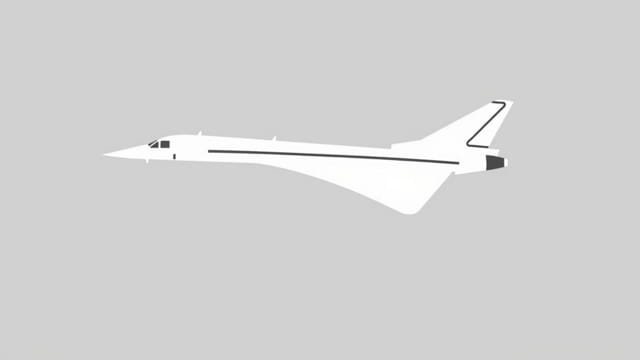
The Concorde, once celebrated as a marvel of aviation engineering, was a supersonic passenger jet that promised to revolutionize air travel by drastically reducing flight times. With its sleek design, needle-nose, and sonic boom capabilities, it became a symbol of luxury, innovation, and speed. However, despite its advanced technology and the fascination it generated, the Concorde ultimately failed as a commercial success. Its downfall wasn’t due to a single cause but rather a combination of economic, environmental, technical, and political factors that made it unsustainable in the long run.
Origins of the Concorde
Joint British-French Effort
The Concorde was developed as a joint venture between the British and French governments in the 1960s, spearheaded by the British Aircraft Corporation and Aérospatiale. It was conceived as the future of air travel, with the goal of transporting passengers at over twice the speed of sound, reaching Mach 2.04.
Engineering Breakthroughs
The aircraft was an engineering feat, capable of flying from London to New York in under 3.5 hours. With its delta wing design, advanced turbojet engines, and sophisticated materials that withstood extreme heat at high speeds, the Concorde stood out in the aviation world.
Technical and Operational Limitations
Limited Seating and Capacity
Despite its advanced technology, the Concorde had a relatively small passenger capacity only about 100 seats. Unlike larger commercial jets such as the Boeing 747, it could not accommodate mass transit and was instead positioned as a luxury option for the wealthy and business elite.
High Fuel Consumption
The Concorde’s four Rolls-Royce/Snecma Olympus 593 engines consumed a tremendous amount of fuel. Its efficiency was far lower than subsonic aircraft, making its operation costly and environmentally burdensome. This limited the jet’s appeal during times of rising fuel prices.
Noise Pollution and Sonic Boom
One of the most controversial aspects of the Concorde was its noise level. Takeoff noise was significantly louder than other commercial aircraft. Moreover, flying faster than the speed of sound caused a sonic boom, which was disruptive to communities below. Due to this, the Concorde was restricted to transoceanic routes, as supersonic travel over land was largely banned.
Economic and Commercial Challenges
Expensive to Operate
The operational costs of the Concorde were extremely high. From specialized maintenance to the cost of parts, every aspect of its service required substantial investment. Airlines struggled to generate enough revenue to justify the costs, especially when fuel prices spiked in the 1970s and 1980s.
Limited Airline Adoption
Although initial interest in supersonic travel was high, only British Airways and Air France ended up operating the Concorde commercially. Other airlines canceled their orders due to cost concerns, political pressure, or economic downturns. As a result, the Concorde never reached the scale needed to be profitable.
High Ticket Prices
To offset operational costs, airlines charged extremely high ticket prices. A round-trip ticket from London to New York on the Concorde could cost over $10,000. This limited its customer base to the wealthy, celebrities, and corporate executives. It never became a mainstream travel option.
Environmental Concerns
Fuel Efficiency and Emissions
As environmental awareness grew, the Concorde came under scrutiny for its fuel inefficiency and high emissions. It consumed far more fuel per passenger than modern subsonic jets, making it a symbol of environmental excess rather than sustainability.
Ozone Layer Impact
Some scientists raised concerns that Concorde’s high-altitude flights could contribute to ozone layer depletion. Although the actual environmental impact remains debated, the perception further damaged its public image.
The 2000 Crash and Declining Confidence
Air France Flight 4590
On July 25, 2000, Air France Flight 4590 crashed shortly after takeoff from Paris Charles de Gaulle Airport, killing all 109 people onboard and four people on the ground. Investigations revealed that debris on the runway had punctured a tire, which caused a chain reaction leading to a fuel tank explosion.
Grounding and Modifications
The crash led to the temporary grounding of the Concorde fleet. Safety modifications were made, including more robust tires and fuel tank protection. Although service resumed in 2001, public confidence had been severely shaken, and passenger demand declined.
Retirement of the Concorde
End of Commercial Service
By 2003, both British Airways and Air France announced the retirement of Concorde. The reasons included high maintenance costs, decreased ticket sales, and the need for extensive upgrades. The final commercial Concorde flights took place in October 2003, ending nearly three decades of supersonic passenger service.
No Replacement Model
Unlike other commercial aircraft, Concorde never had a successor. No government or manufacturer has since developed a commercially viable supersonic airliner, largely due to the same economic and technical barriers that led to Concorde’s demise.
Legacy and Lessons Learned
Symbol of Ambition and Innovation
Despite its failure as a commercial venture, the Concorde remains an icon of technological ambition. It demonstrated what was possible when governments and engineers pushed the boundaries of aviation design. Museums around the world now preserve Concorde aircraft as symbols of a bygone era.
Barriers to Supersonic Travel
- High fuel consumption and environmental costs
- Regulatory restrictions on sonic booms
- Maintenance and operational complexity
- Limited market size and high ticket pricing
Influence on Future Designs
Modern aerospace companies continue to explore supersonic and hypersonic technologies. However, future designs aim to address the problems Concorde faced, such as reducing noise, improving fuel efficiency, and making ticket prices accessible. New projects from companies like Boom Supersonic and NASA’s X-59 aim to reintroduce supersonic travel, but on more sustainable and economically viable terms.
The Concorde failed not because it lacked innovation or speed, but because it could not overcome the economic, environmental, and practical limitations of its time. It was ahead of its era in many ways, yet out of step with market demands and global trends. Although its era has ended, the dream of faster-than-sound commercial travel still captures the imagination of engineers, travelers, and aviation enthusiasts alike. The legacy of Concorde lives on not just as a reminder of what once flew across the skies, but as inspiration for what future flight might still achieve.