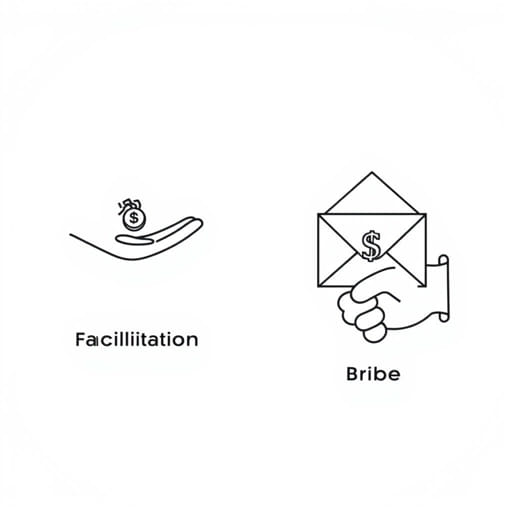
Facilitation payments and bribes are terms often heard in discussions about corruption, international business ethics, and legal compliance. While both involve the exchange of money or gifts to influence an outcome, there is a fine line between what may be legally tolerated in some jurisdictions and what is clearly considered unethical or illegal. For companies operating across borders, understanding the distinction between facilitation payments and bribes is crucial for maintaining reputations, avoiding legal trouble, and upholding anti-corruption standards. Misunderstanding the difference can lead to serious consequences, including fines, imprisonment, or damage to business credibility.
Defining Facilitation Payments
What Are Facilitation Payments?
Facilitation payments, also known as grease payments, are typically small sums of money paid to public officials to expedite or secure the performance of a routine, non-discretionary governmental action. These actions are usually things the official is already obligated to do, such as:
- Processing a visa or permit
- Clearing goods through customs
- Providing police protection or mail delivery
- Connecting utilities like electricity or water
These payments are not meant to influence the outcome of a decision but to speed up the process or ensure it happens without unnecessary delay. In some countries, facilitation payments have been tolerated under local practices or explicitly exempted under law, although this is increasingly rare.
Legal Ambiguity of Facilitation Payments
The legality of facilitation payments varies by country. For example:
- In theUnited States, the Foreign Corrupt Practices Act (FCPA) allows a narrow exception for facilitation payments, provided they are made to expedite routine actions and not to gain an unfair advantage.
- In theUnited Kingdom, the Bribery Act 2010 strictly prohibits facilitation payments, treating them as bribes regardless of their size or purpose.
- ManyOECD countriesand international anti-corruption conventions also discourage or outright ban facilitation payments.
Even when technically legal in some jurisdictions, facilitation payments can still violate internal company policies, investor expectations, or international business ethics standards.
Understanding Bribes
What Is a Bribe?
A bribe is a payment, gift, favor, or advantage offered or given to influence the actions or decisions of a person in a position of power. Bribes aim to obtain favorable treatment or outcomes that the payer is not entitled to under the law. Examples include:
- Paying a judge to dismiss a lawsuit
- Offering money to a government official to win a contract
- Giving a gift to secure favorable tax treatment
- Offering tickets, trips, or luxury goods in exchange for business opportunities
Bribery is illegal in almost all jurisdictions and is universally condemned as corrupt behavior. It undermines the rule of law, distorts competition, and erodes public trust in institutions.
Legal and Ethical Implications of Bribery
Unlike facilitation payments, bribes have no legal tolerance in any major international legal system. Anti-bribery laws often apply extraterritorially, meaning companies can be prosecuted in their home country for bribery committed abroad. Key anti-bribery laws include:
- The U.S.FCPA(Foreign Corrupt Practices Act)
- The U.K.Bribery Act 2010
- TheOECD Anti-Bribery Convention
- TheUN Convention Against Corruption
Penalties for bribery can include hefty fines, imprisonment, debarment from public contracts, reputational harm, and the loss of licenses or partnerships. Many companies have adopted strict zero-tolerance policies on bribery to comply with international standards and avoid legal exposure.
Facilitation Payment vs Bribe: Key Differences
Although both facilitation payments and bribes involve money given to public officials, there are several critical distinctions:
- Purpose: Facilitation payments are made to expedite routine actions; bribes are given to influence decisions or outcomes that benefit the payer unfairly.
- Legality: Facilitation payments may be legal in limited circumstances; bribes are illegal in virtually all jurisdictions.
- Impact: Facilitation payments support routine operations; bribes corrupt decision-making and promote unfair advantages.
- Risk: Facilitation payments carry compliance and reputational risks; bribes carry criminal liability and global condemnation.
- Transparency: Facilitation payments may sometimes be recorded in financial statements; bribes are often concealed or disguised.
Despite these distinctions, many governments and organizations treat both as corrupt practices, especially due to the difficulty of distinguishing between a minor facilitation payment and a disguised bribe.
Global Trends and Anti-Corruption Efforts
Declining Acceptance of Facilitation Payments
There is a growing global movement to eliminate facilitation payments entirely. While some countries once tolerated small payments to grease the wheels of bureaucracy, the trend is shifting toward stricter enforcement of anti-corruption laws. Organizations such as Transparency International and the OECD advocate for the complete ban of facilitation payments, arguing that:
- They perpetuate a culture of corruption.
- They create unfair barriers for honest businesses.
- They can escalate into larger, more damaging forms of bribery.
Multinational corporations are also implementing strong compliance programs and training to ensure employees understand the risks associated with both facilitation payments and bribes.
Corporate Responsibility and Compliance
Companies operating internationally must develop clear anti-bribery policies that include provisions on facilitation payments. Key strategies include:
- Providing employee training on anti-corruption laws
- Establishing internal reporting and whistleblower systems
- Conducting due diligence on third parties and agents
- Monitoring and auditing financial transactions
- Implementing strong disciplinary measures for violations
Firms that fail to address the risks of facilitation payments may find themselves entangled in legal investigations, public scandals, and financial losses.
Real-World Examples and Cases
There have been numerous high-profile cases where companies were penalized for making what they claimed were facilitation payments, only to have them ruled as bribes by authorities. For example, several multinational corporations have been fined under the FCPA for payments made to customs or port officials in developing countries. These payments were classified not as legal facilitation payments but as bribes because they involved discretion or resulted in competitive advantages.
Such cases illustrate the blurry line and the importance of a cautious, zero-tolerance approach, even when operating in regions where small payments are the norm.
Distinguishing between facilitation payments and bribes is more than a legal exercise it is a matter of ethics, corporate governance, and global responsibility. While facilitation payments may appear less harmful than outright bribes, they contribute to a broader culture of corruption and carry significant legal and reputational risks. The international community is moving toward eliminating both practices through stronger regulations, corporate accountability, and ethical leadership. For businesses and individuals alike, the safest path is to reject any form of unofficial payment and commit to transparent, lawful, and fair conduct in all dealings.
#kebawah#