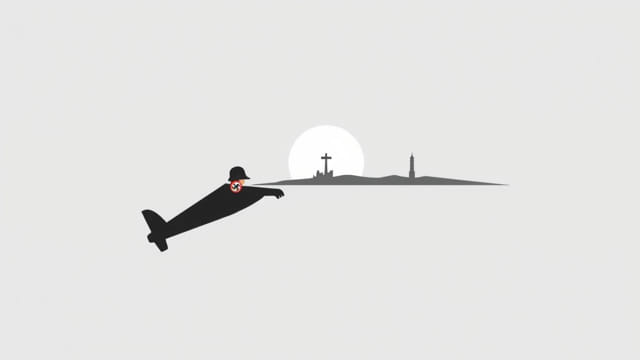
In May 1941, a dramatic and unexpected event unfolded in the midst of World War II. A high-ranking Nazi official made a daring solo flight from Germany to Great Britain, creating shockwaves throughout Europe. This individual, known for his influence within the Nazi hierarchy, was not just any pilot but a close confidant of Adolf Hitler. His journey across enemy lines raised questions, sparked political intrigue, and has remained one of the most curious incidents of the war. The Nazi who flew to England was Rudolf Hess, and his motives, mission, and consequences remain a subject of deep historical interest.
Who Was Rudolf Hess?
Rudolf Hess was born in 1894 in Alexandria, Egypt, to a wealthy German merchant family. He later moved to Germany and served as a soldier during World War I. After the war, Hess became involved in nationalist politics and joined the fledgling Nazi Party. He quickly became one of Hitler’s most loyal followers and was present during the failed Beer Hall Putsch in 1923. After serving time in prison alongside Hitler, Hess helped transcribe parts of Hitler’s book,Mein Kampf.
As the Nazi Party rose to power, Hess gained prominence and eventually became Deputy Führer in 1933. This position placed him high in the chain of command, responsible for internal party affairs and closely associated with Nazi ideology. However, by the late 1930s, Hess’s influence waned due to the rise of other powerful figures like Heinrich Himmler and Hermann Göring.
The Secret Mission to Scotland
On May 10, 1941, as the war in Europe raged, Rudolf Hess shocked his peers by taking off from Augsburg in a Messerschmitt Bf 110 aircraft. He flew alone across the North Sea, navigating dangerous airspace. His destination was Dungavel House in Scotland, the estate of the Duke of Hamilton. Hess believed that Hamilton could help him broker peace between Nazi Germany and Britain.
According to Hess, his goal was to negotiate an end to the war with the United Kingdom so that Germany could focus its efforts on its impending conflict with the Soviet Union. He assumed that not all British leaders were aligned with Winston Churchill’s hardline stance and believed a faction would be open to peace. Unfortunately for Hess, the British government was caught off guard and responded with suspicion rather than diplomacy.
British Reaction and Capture
Upon landing, Hess parachuted from his plane and was soon captured by a local farmer. He identified himself under an alias but eventually revealed his true identity. British authorities were astonished by the arrival of such a high-profile Nazi figure. Initially, they kept his presence a secret, fearing that the incident might be a trick or part of a larger scheme.
Winston Churchill, informed of the capture, dismissed Hess’s mission as delusional. The British government refused to enter any negotiations and treated him as a prisoner of war. His arrival did not lead to any peace talks and, instead, was used by the Allies as a propaganda tool to emphasize divisions within the Nazi leadership.
German Response to Hess’s Flight
Back in Germany, the Nazi regime was outraged. Adolf Hitler was said to be furious and publicly declared that Hess had acted on his own initiative and without approval. Joseph Goebbels, the Nazi propaganda minister, downplayed the event, framing Hess as mentally ill and emotionally unstable. Hess was stripped of all his positions and titles, and his name was erased from official Nazi communications.
There were speculations that Hitler may have initially approved the mission in secret but later distanced himself when it failed. Some historians suggest internal power struggles and Hess’s marginalization may have influenced his drastic decision to pursue peace alone.
Imprisonment and the Nuremberg Trials
Rudolf Hess spent the remainder of the war imprisoned in Britain under strict supervision. After the Allied victory, he was among the top Nazi officials tried at the Nuremberg Trials in 1946. Charged with crimes against peace and conspiracy to commit crimes against humanity, Hess presented a confusing defense and claimed to have suffered from memory loss.
Though acquitted of war crimes and crimes against humanity, Hess was convicted on two counts and sentenced to life imprisonment. He was sent to Spandau Prison in Berlin, where he remained for over four decades. Hess became the sole inmate at Spandau from 1966 onward, as other prisoners were released. His solitary confinement and aging led to international debate about the fairness of his continued imprisonment.
Death and Legacy
Rudolf Hess died in 1987 at the age of 93, officially by suicide. He was found hanged in a summerhouse on the prison grounds, though conspiracy theories persist that he may have been murdered. After his death, his grave became a neo-Nazi pilgrimage site, leading German authorities to exhume and cremate his remains in 2011 to prevent it from becoming a symbol for extremist groups.
The legacy of Hess’s flight remains one of the more unusual episodes of World War II. Some interpret his mission as a sincere, if misguided, attempt at peace. Others see it as a reflection of desperation and internal divisions within the Nazi regime. In either case, it revealed much about the instability of Hitler’s inner circle and the individual ambitions of its members.
Key Points of the Rudolf Hess Incident
- Rudolf Hess was a top-ranking Nazi official and Deputy Führer of Germany.
- In May 1941, he flew solo to Scotland in an effort to negotiate peace with Britain.
- His mission failed, and he was imprisoned by British authorities.
- Hitler disavowed Hess’s actions and labeled him as mentally unstable.
- Hess was tried at Nuremberg and sentenced to life imprisonment.
- He spent over 40 years in prison, dying in 1987 under mysterious circumstances.
The story of the Nazi who flew to England Rudolf Hess remains one of the most perplexing events of World War II. His bold flight, driven by personal conviction and political misjudgment, failed to achieve any diplomatic breakthrough and instead highlighted the fragmented nature of Nazi leadership. For historians, Hess’s mission stands as a powerful reminder of how ambition, isolation, and ideology can drive even the most powerful figures to take extraordinary and futile risks.