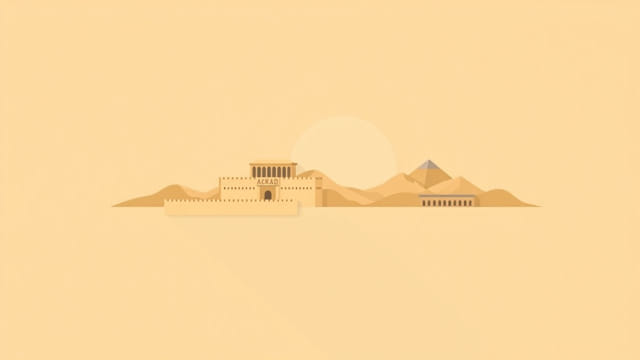
The city of Akkad was once the heart of one of the world’s earliest empires, yet its precise location remains a mystery to modern archaeologists. As the capital of the Akkadian Empire, founded by the legendary king Sargon of Akkad around 2334 BCE, this ancient city played a pivotal role in shaping Mesopotamian civilization. Despite its importance in history, no one has definitively discovered the ruins of Akkad, leaving scholars to rely on historical records, inscriptions, and educated speculation. The question of where the city of Akkad is located continues to intrigue historians and archaeologists alike.
The Rise of Akkad and Its Historical Importance
Origins of the Akkadian Empire
The Akkadian Empire emerged in Mesopotamia, a region located between the Tigris and Euphrates Rivers, in what is today modern-day Iraq. It is considered the world’s first empire because it unified various Sumerian city-states under one centralized rule. This unification was achieved by Sargon of Akkad, who conquered territories from the Persian Gulf in the south to parts of Syria and Anatolia in the north and west.
Akkad was the capital city of this vast empire, and its name became synonymous with imperial power, language, and culture. Akkadian, a Semitic language, gradually replaced Sumerian as the dominant spoken and written tongue in Mesopotamia. Akkad, therefore, was not only a political center but also a cultural and linguistic hub of the ancient world.
Mentions in Ancient Texts
References to Akkad appear in various Mesopotamian texts, including royal inscriptions, administrative tablets, and mythological stories. The city is described as being rich, powerful, and closely associated with Sargon and his descendants. Akkad is often mentioned alongside cities such as Babylon, Uruk, and Ur. Despite these frequent references, none of the texts provide clear, unambiguous geographic coordinates.
Searching for the Lost City of Akkad
Possible Locations
While the exact location of Akkad has never been confirmed through excavation, most scholars believe it was located in northern Babylonia, somewhere near the confluence of the Tigris and Euphrates Rivers. Several possible locations have been proposed based on interpretations of historical texts and satellite imagery:
- Near Baghdad: Some researchers suggest Akkad was located north of modern-day Baghdad, possibly near the ancient city of Sippar.
- South of Samarra: Other theories place it along the western bank of the Tigris River, near Samarra, an area that remains largely unexplored archaeologically.
- Near Kish or Babylon: Some believe Akkad may have been near Kish or even in the vicinity of Babylon, both prominent cities in ancient Mesopotamia.
Unfortunately, due to urban development, environmental changes, and conflict in the region, many ancient sites remain inaccessible or have been damaged, making archaeological discovery more difficult.
Why Has Akkad Not Been Found?
The city of Akkad may not have survived the centuries due to natural and human factors. Flooding, erosion, and shifting river courses in Mesopotamia have buried or destroyed many ancient cities. Moreover, later civilizations may have dismantled Akkad’s structures to reuse the materials in new construction projects.
Unlike cities such as Ur or Nineveh, which have distinct architectural remains and ziggurats, Akkad may have lacked monumental buildings that could survive long-term degradation. Additionally, war and looting in modern times have severely hampered archaeological efforts in Iraq.
Legacy of the City of Akkad
A Cultural and Political Beacon
Even though the physical city remains lost, Akkad’s legacy endures. It marked the beginning of imperial rule in the ancient Near East, creating a blueprint for future empires. The administrative system, road networks, and military organization established during the Akkadian Empire influenced successive cultures, including the Babylonians and Assyrians.
The Akkadian Language
The spread of the Akkadian language is one of the city’s most lasting contributions. Written in cuneiform script, Akkadian became the diplomatic and scholarly language of the ancient Near East for over a thousand years. Texts in Akkadian have been found as far as Egypt, Anatolia, and Iran, showing the wide reach of its influence.
Mythological Significance
Akkad also holds a place in Mesopotamian mythology. Kings of later periods, such as Naram-Sin, Sargon’s grandson, were deified, and their exploits were mythologized. Akkad became a symbol of divine favor, imperial power, and eventually divine punishment when the empire fell due to rebellion, invasion, and possibly climate change.
Modern Archaeological Efforts
Technological Advances
Recent advancements in satellite imaging and remote sensing have opened new possibilities in the search for lost cities like Akkad. Researchers now use high-resolution satellite photos to identify subtle changes in soil patterns, moisture, and vegetation, which can indicate buried structures or roadways.
Challenges in Iraq
Political instability and security concerns in Iraq have long hindered archaeological missions. Looting during wars and neglect of historical sites has led to the loss of valuable information. However, collaborative efforts between Iraqi authorities and international institutions continue to work toward preserving and studying Mesopotamian heritage.
The Elusive Capital of an Ancient Empire
The city of Akkad, though physically lost to history, remains one of the most important centers of ancient Mesopotamian civilization. It was likely located in northern Babylonia, near the Tigris and Euphrates Rivers, possibly in present-day Iraq north of Baghdad. Despite the lack of archaeological evidence, its influence is visible through language, literature, administration, and mythology.
The search for Akkad continues to captivate the imagination of scholars and history enthusiasts. While the exact coordinates of the city may remain unknown, its significance is undisputed. The mystery surrounding its location only adds to its allure, reminding us that much of human history still lies buried beneath the sands of time, waiting to be rediscovered.